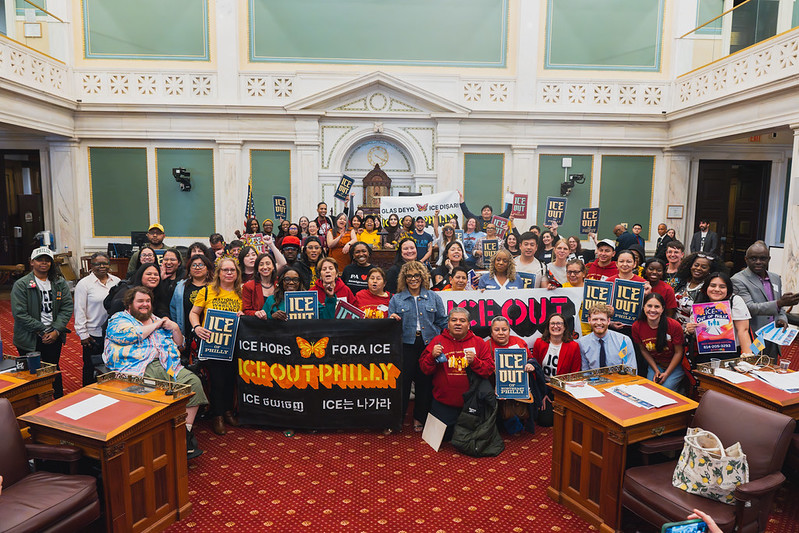
Philadelphia — On Monday April 13th, City Council’s Committee of the Whole voted unanimously in support of ICE OUT legislation introduced by Minority Leader Kendra Brooks and Councilmember At-Large Rue Landau. The legislation makes it illegal for agents to hide their identities with face masks and unmarked vehicles; prohibits the City from collaborating and sharing data with ICE; expands anti-discrimination protections related to immigration status; and restricts ICE activity in city-owned spaces. The seven-bill package is one of the most comprehensive legislative efforts from a local government to push back against Trump’s violent anti-immigrant agenda.
“With ICE set to receive billions in new funding, buying detention centers in our surrounding counties, and routinely being deployed to police our cities, silence is no longer an option,” said Minority Leader Kendra Brooks. “People want to know what we are doing to protect this city. With the ICE Out package, we are showing them.”
“Today’s committee vote on the ICE OUT package affirms that we will stand with our immigrant communities and refuse to turn our backs on those who call this city home. Philadelphia has always been a city shaped by immigrants. This legislation honors that legacy by ensuring our policies reflect the dignity and respect that our neighbors deserve every day, and ensuring that we protect their safety,” said Councilmember Rue Landau (At-Large), “The voices of working Philadelphians were heard, and they are at the heart of this legislation. This is what community-driven policy looks like.”
During the hearing, the public learned for the first time that the Philadelphia Police Department has issued a memo directing officers not to collaborate with ICE. Additionally, the Parker administration has created a memo for City employees entitled “Guidance on Interacting with External Government Officials on City Property.” According to Charlie Ellison, Director of the Office of Immigrant Affairs, the City will provide virtual training sessions for employees on this topic in the coming weeks.
“While immigration enforcement is a federal matter, under the Tenth Amendment, state and local governments can opt out of participation in important and meaningful ways,” said Vanessa Stine, Senior Staff Attorney with the American Civil Liberties Union (ACLU) of Pennsylvania. “This is the strong legal ground that the ICE Out legislation stands on: Philadelphia’s choice to minimize their entanglement with abusive and discriminatory federal immigration programs.”
“Some might try to make the argument that ICE agents in our communities are not a ‘labor’ or ‘union’ issue. I disagree,” said Danny Bauder, President of the Philadelphia AFL-CIO. “Some of Philly’s largest unions, such as SEIU 32BJ, AFSCME DC 47, PFT Local 3, and Unite Here Local 274, have already signed on as supporters of this legislation. Why? Because the threat of ICE and forced deportation is a real threat to their members, union workers, and their families.”
“Our communities need our police and other city agencies to focus on serving them, not engaging in immigration enforcement,” said Keisha Hudson, Chief Defender of the Defender Association of Philadelphia. “Measures that prevent law enforcement from concealing their identity while performing official duties promote accountability. These bills help build trust between our city government and our residents.”
Gerardo, a small business owner who came to Philadelphia as an immigrant twenty years ago, testified about the ripple effect of ICE’s presence: “The impact is devastating. Entire families are in lockdown. Workers are being detained. They have no income—unable to pay rent, unable to put food on the table. Businesses—restaurants, food trucks, small shops—are closing one after another, not because they want to, but because they have no other choice.”
With a favorable recommendation from the Committee, the legislation will go to City Council for a final vote as soon as Thursday, April 23. Once the legislation passes out of City Council, Mayor Parker will have the opportunity to sign the bills into law.
ICE Out legislation was introduced in City Council in January and protects communities in four key areas:
- ICE Out of the shadows: Prohibits ICE and other law enforcement agents from hiding their identity with face masks and unmarked vehicles.
- ICE Out of city data: Codifies executive orders banning 287(g) agreements, which allow local police to act as ICE agents, prohibits city agencies from collaborating with ICE, and prevents city agencies from collecting citizenship and immigration status data or sharing any kind of personal data with ICE.
- ICE Out of city functions: Prohibits anyone, including the city, employers, housing providers, or private businesses to discriminate or refuse services on the basis of citizenship or immigration status.
- ICE Out of city spaces: Prohibits ICE from using city-owned properties as staging locations for raids and prohibits employees from granting ICE access to city-owned spaces like libraries, shelters, health centers or rec centers without a judicial warrant.
Over seventy organizations signed on in support of the legislation, and thousands of Philadelphians signed a petition calling on City Council and Mayor Parker to pass the legislation into law.
##
